
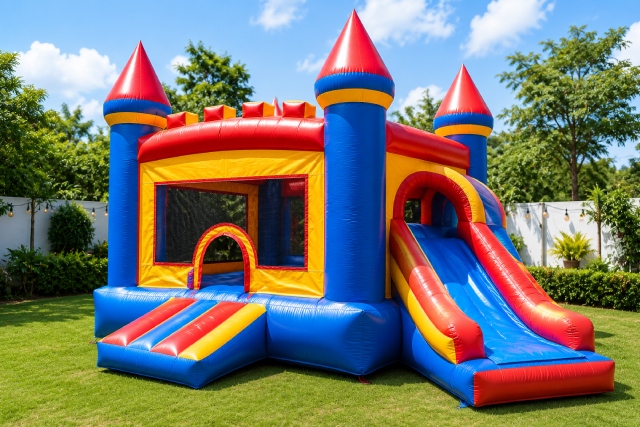
So, you’ve decided a bouncy castle is happening at your next party. That’s definitely a brilliant choice since nothing gets a garden full of kids buzzing quite like a giant inflatable castle. But before you get carried away picking colours and themes, there’s one crucial step that trips up more hosts than you’d think: making sure your venue can actually handle it.
It happens more often than you’d expect. A garden or hall looks spacious and dreamy in photos, then you turn up in person and realise it’s a fraction of the size you imagined, or there’s a tree branch exactly where the castle needs to go. The good news? A little bit of checking beforehand saves you from a stressful, deflating surprise on the big day (pun very much intended). Let’s walk through exactly what to look for.
How Do I Know If My Venue Can Fit A Bouncy Castle?
Grab a tape measure and go old school by measuring the actual venue space in person, then add a buffer of at least 60 to 90 centimetres on every side for anchoring, safe entry and exit, and room for an adult to keep an eye on things. As a rough rule of thumb, a standard bouncy castle needs a clear footprint of around 450cmx45cm, while bigger combo units or obstacle courses can creep up towards 700cmx700cm or more once you factor in the blower unit and anchor points.
Rental companies will usually ask for your exact measurements before recommending a size, and for good reason: this is the single biggest factor in whether your event day runs smoothly or not. Skipping this step or eyeballing it is where most venue mishaps start.
Why Does My Venue Look Bigger Online Than It Actually Is?
Here’s the honest truth: photos lie, just a little. Wide-angle lenses, clever staging, and generous square-footage estimates on listing sites can all make a space look roomier than it really is. It’s not necessarily anyone being sneaky, but rather it’s just how photography and marketing work.
This is exactly why an in-person walkthrough (or at the very least, a video call with the venue) is worth the extra effort. Bring your tape measure, note down any obstructions like support beams, garden furniture, or awkward slopes, and if possible, ask the venue for a proper to-scale floor plan rather than relying on the hero shot on their website. A five-minute site check now can save you from a very awkward “it just doesn’t fit” conversation on the day.
Tips for Checking The Ground Surface
Flat, level grass is the gold standard for a bouncy castle setup. It’s soft, easy to anchor into with stakes, and it gives everyone a safer landing if things get a bit rowdy. Concrete, decking, or indoor flooring can still work, but only if your rental company can switch to sandbags or weighted anchors instead of ground stakes.
Beyond the surface type itself, take a proper look around the space. Is the ground sloped or uneven? Are there sprinkler heads, tree roots, or paving stones poking up? And don’t forget to check with the venue itself (not just the rental company) about whether stakes are even allowed in the ground — some managed venues have strict rules in this regard.
Is There Enough Overhead Clearance?
This one catches people out constantly: it’s not just about floor space, it’s about what’s above your head too. Most bouncy castles need somewhere between 400 and 450 cm of vertical clearance, and combo units with slides can require even more.
Indoors, that means checking ceiling height, light fittings, and any low beams. Outdoors, keep an eye out for overhanging tree branches, power lines, gazebo frames, or awnings. It’s easy to measure a garden’s width and length and completely forget to look up, so make “look up” an official part of your venue check.
Does My Venue Have Power And Access For Setup?
Most inflatables need a nearby standard power outlet (or a generator, if one isn’t available) to keep the blower running continuously throughout your event. Without steady airflow, your castle will start to sag, which is not the look you’re going for mid-party.
It’s also worth thinking beyond the setup spot itself. How will the delivery crew actually get the castle into position? Is there a gate code needed, a flight of stairs, a narrow side entrance, or limited parking nearby? For indoor venues, check whether there’s lift access if the space isn’t on the ground floor. None of this is dealbreaker stuff, but flagging it early means your rental company can plan for it instead of scrambling on the day.
What If Bad Weather Is A Risk At My Venue?
Straight up: outdoor bouncy castles can’t safely operate in heavy rain or strong wind, full stop. Wet surfaces get slippery, and gusty conditions can genuinely make an inflatable unsafe, whatever the age of the bouncers inside.
If your venue is outdoor-only with zero backup, that’s a real risk worth thinking through before you book. Ask your rental company about their weather and rescheduling policy upfront, and check whether your venue has any covered space — a marquee, a hall, a garage — that could serve as a plan B if the forecast turns on you.
My Venue Isn’t Ideal For A Bouncy Castle — What Are My Options?
Here’s the bit you’ll actually want to bookmark. If you’ve gone through all of the above and your venue just isn’t playing ball with a full-size bouncy castle, don’t panic and don’t scrap the inflatable fun altogether; there’s almost always a smart alternative.
- Tight or oddly shaped garden? A smaller or toddler-sized bounce house is lower to the ground, purpose-built for younger kids, and far easier to squeeze into a compact space while still being simple to supervise.
- Uneven ground, hard flooring, or no stake access? Interactive inflatable games like obstacle courses, bungee runs, gladiator joust arenas, or basketball shootouts often need less anchoring and can be secured with weights rather than stakes.
- Want the wow factor without the footprint? A combo unit with a built-in slide is often more space-efficient than trying to squeeze in multiple separate inflatables.
- Big open venue and a mixed-age crowd to entertain? An inflatable obstacle course tends to spread guests out rather than cluster them in one spot, which genuinely makes supervision easier at larger events. Just be aware it needs a longer, wider footprint than a standard castle.
The takeaway here: a tricky venue is a puzzle to solve, not a party-ender. There’s an inflatable out there for pretty much every space.
What Else Should I Confirm Before Booking?
Before you sign anything, double-check that your rental company holds proper liability insurance, especially if a deal looks suspiciously cheap. It’s also worth asking them to do a final measurement check, whether that’s a quick call, some photos, or an in-person visit, before the big day arrives. And always get their cancellation and weather policy in writing so there are no surprises later.
Ready To Bounce? Let’s Make Sure Your Party Sticks The Landing
Checking your venue properly might not be the most glamorous part of party planning, but it’s genuinely the difference between a smooth, joy-filled celebration and a stressful last-minute scramble. Measure twice, look up, check the ground, and always have a weather backup — do that, and you’re setting yourself up for a party people will actually remember for the right reasons.
And if you’re still not sure whether your space is bouncy-castle-ready, that’s exactly what we’re here for. Reach out to our team today and we’ll help you figure out the perfect inflatable fit for your venue, whether that’s a classic bouncy castle, a show-stopping water slide, or an obstacle course that’ll keep everyone entertained for hours.
Frequently Asked Questions
1. How much space do I actually need for a bouncy castle?
Most standard bouncy castles need a clear footprint of around 15×15 feet, including room for anchoring and safe entry and exit. Larger combo units, slides, or obstacle courses will need considerably more, so always check the exact dimensions with your rental company.
2. Can a bouncy castle be set up on concrete or decking?
Yes, in many cases — as long as your rental company can secure it using sandbags or weighted anchors instead of ground stakes. Just flag your surface type when booking so they bring the right equipment.
3. What happens if it rains on the day of my party?
Bouncy castles can’t safely be used in heavy rain or strong wind, so it’s important to ask your rental company about their weather policy before booking. Having a covered backup space at your venue is also a smart move.
4. Do I need a specific type of power supply for a bouncy castle?
Most inflatables just need a standard nearby power outlet to keep the blower running throughout the event. If your venue doesn’t have easy access to one, a generator can usually be arranged instead.
5. What’s a good alternative if my venue is too small for a full bouncy castle?
A smaller or toddler-sized bounce house is a great option for tighter spaces, as it has a lower profile and smaller footprint while still delivering plenty of bouncing fun.
6. Is an inflatable obstacle course better than a bouncy castle for a bigger event?
For larger gatherings with a mixed-age crowd, obstacle courses often work brilliantly since they spread guests out across a longer layout rather than clustering everyone in one bouncing area, which can make supervision easier.