
The bouncy castle looks perfect in the booking photos, the guest list is finalised, and the cake has been ordered. But somewhere between the delivery van pulling up and the last exhausted child being carried out to the car, an entire sequence of setup, checking and timing is unfolding that most hosts never think to ask about.
Understanding roughly how a bouncy castle rental day actually unfolds, from the moment the crew arrives to the moment they drive off again, helps events run without last-minute scrambling. This is especially true for larger gatherings such as school carnivals or corporate family days, where several other suppliers and a fixed programme are all competing for the same few hours. Here is a realistic breakdown of where the time tends to go.
Sorting the Details Before Delivery Day
Many of the surprises that derail an event day were actually decided weeks earlier: the width of the corridor leading to a function room, whether the void deck has a kerb the crew needs to work around, how many hours the school field has actually been booked for. Hosts who work through everything you need to check well before booking, lift size, ceiling height, ground surface and power access among them, tend to find their delivery morning calmer than those who leave it to chance. That groundwork will not remove every timeline pressure on the day itself, but it does remove the kind that catches everyone off guard.
Delivery and Setup: The First Hour or Two
Most residential bookings are scheduled with a delivery window rather than an exact minute, usually a stretch of thirty minutes to an hour, since traffic and the previous job of the day can shift things slightly. Once the crew arrives, the actual physical work moves quickly for a single bouncy castle, though a water slide inflatable or an obstacle course, being larger, takes noticeably longer to lay out and inflate properly.
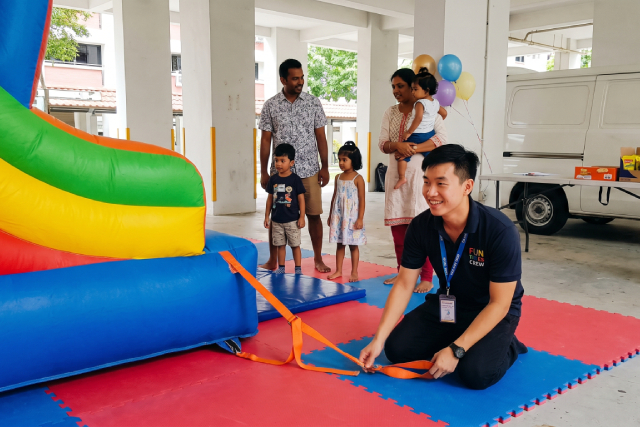
A typical setup sequence includes laying protective ground matting where the surface calls for it, positioning the inflatable clear of walls, drains and overhead obstructions, connecting and running the blower to check for even inflation, securing every anchor point appropriate to the surface, and walking the host through the basic operating and shutdown steps. None of these can sensibly be rushed, since a poorly anchored unit or an unchecked seam is exactly the kind of thing that turns into a problem later in the day.
For a single unit at a straightforward venue, this whole process often wraps up within thirty to forty-five minutes. Add a second inflatable, a trickier access route, or a venue where the crew is sharing space with other vendors setting up at the same time, and it is sensible to allow closer to an hour before guests are expected to arrive.
The Safety Check Before Anyone Jumps In
Once everything is inflated and anchored, there is a final walk-through before children are allowed on. This covers the same ground as the setup checks but from the perspective of someone about to use the equipment: is the surface fully firm, are all seams and stitching intact, is the blower running steadily, and is the immediate surrounding area clear of anything that could be tripped over or fallen onto. It rarely takes more than a few minutes, but skipping it to save time defeats the point of having it at all.
This is also a sensible moment to glance at the day’s conditions. Singapore’s weather can shift quickly, and hosts running an outdoor event often check the Meteorological Service Singapore’s four-day outlook the morning of, or even the evening before, so that any sign of an approaching downpour gets factored into the run of play well before it becomes a mid-party surprise.
Keeping the Timeline Steady Once Guests Arrive
Once play begins, the timeline mostly runs itself, provided someone is keeping half an eye on numbers and rotation, particularly for younger children sharing the space with older ones. Larger events with a printed programme, awards, a lunch break, other performances, tend to build in natural pauses that double as informal rest periods for the inflatable and its users alike.
Pack-Down and What Determines How Long It Takes
Pack-down is usually the quickest part of the day, though it never feels that way to a host who is simultaneously trying to thank departing guests and locate a missing shoe. The blower is switched off, the unit deflates over a few minutes, and the crew folds, straps and loads it back onto the van, generally in less time than the setup took, since there is no positioning or anchoring left to figure out.
How long it actually takes still depends on a handful of factors: the number of inflatables being packed away, how far the van is parked from the setup point, whether the ground has become wet or muddy during the event, and how straightforward the access route is once furniture or other vendor equipment has been moved back into place. A single unit on flat, dry ground close to the loading point might be gone within twenty minutes, while a multi-inflatable school event on a soggy field understandably takes longer.
None of these figures are meant to be exact promises, since every venue and guest list is different, but they do give a realistic sense of what to expect instead of leaving hosts to guess. Building in a little buffer at both ends of the day, before delivery and after the last guest leaves, tends to make the difference between a schedule that holds up and one that quietly falls apart by mid-afternoon.
If you are mapping out the run of show for an upcoming party, carnival or family day, our team is happy to talk through timing for your specific venue before you lock in a date. Feel free to get in touch and we can help you build a schedule that actually works on the day.