
Somewhere on every outdoor event planning checklist sits an item nobody wants to think too hard about: what happens if it rains. For a country that sits almost on the equator, Singapore’s weather is remarkably changeable within a single afternoon, and an event that looked perfectly timed on the calendar can suddenly be racing a bank of dark clouds rolling in from the west.
This is not a reason to avoid outdoor bouncy castles, water slides or obstacle courses altogether. It is a reason to plan for outdoor events during Singapore’s monsoon season with the same care given to guest lists and catering, so that a shift in the weather becomes a manageable adjustment instead of a scramble. Most of that planning happens quietly, well before the event date, and rarely needs to be complicated once the basic seasonal pattern is understood.
Singapore’s Wet Weather Calendar, in Brief
Singapore does not experience a single rainy season so much as a rotation of them. According to the Meteorological Service Singapore’s overview of Singapore’s monsoon seasons, the Southwest Monsoon runs roughly from June to September and brings sudden early-morning Sumatra squalls along with brief afternoon thunderstorms, while the Northeast Monsoon from December to early March opens with a wetter phase of widespread, sustained rain before turning drier and windier from late January. Sandwiched between the two, the October to November inter-monsoon period tends to bring the year’s heaviest and most unpredictable afternoon downpours, with thunderstorms typically building through the afternoon and early evening instead of at the start of the day.
Why the Next Few Months Need Extra Planning
Anyone booking an outdoor event for the final quarter of the year is effectively planning across two different weather patterns at once. A family day scheduled in October or November sits inside the wetter inter-monsoon window, while anything booked for December, which is also peak season for school holiday parties and year-end company celebrations, runs straight into the start of the Northeast Monsoon.
None of this means outdoor events should be pushed indoors as a rule. It simply means the planning conversation for a November or December booking should include weather from the outset, not as an afterthought once the forecast starts looking unfriendly a few days out.
Building a Rain Contingency Into the Plan
A workable contingency does not need to be complicated, but it does need to be decided before the event, not during it. Most experienced organisers settle on one of the following approaches well ahead of time:
- A covered backup location, such as a function room, hall or sheltered court, that guests can move to with minimal disruption to the programme.
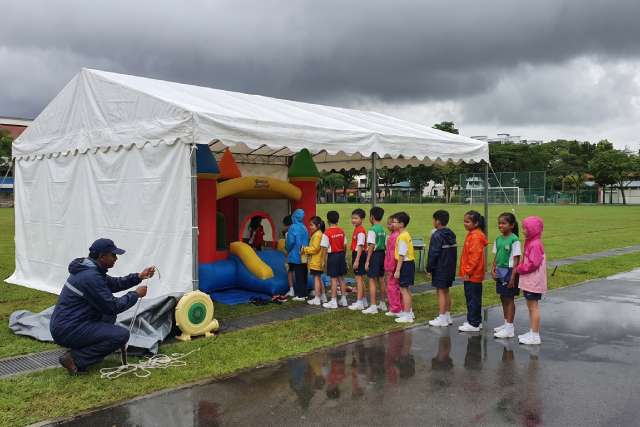
- A canopy or tentage over the inflatable itself, which allows play to continue through light rain and protects the equipment between showers.
- A flexible start or end time, giving some room to shift the programme by half an hour if a squall is forecast to pass through early.
- A clear postponement or rescheduling understanding agreed with all vendors in advance, so nobody is negotiating terms mid-event.
- A realistic guest communication plan, so families are not left checking group chats for updates while standing in the rain.
Equipment care is part of this conversation too. A brief shower does no lasting harm to a bouncy castle or water slide inflatable, but the surface does need to be dried off before it is folded away, since packing damp material into a bag for any length of time is how mildew and unpleasant smells set in. Any experienced crew will already build this into their pack-down process, wiping the equipment down before it goes back on the van instead of leaving it until the next job.
Deciding on one of these in the planning stage, rather than improvising when the sky darkens, is usually what separates an event that recovers gracefully from one that simply ends early.
What Happens If Rain Hits Mid-Event
If rain does start during play, the usual response is straightforward: the inflatable is paused, guests move to shelter, and play resumes once conditions and the equipment itself have been checked again. A brief shower rarely ends an event outright, though sustained heavy rain, thunder or strong gusts calls for keeping everyone off the equipment until conditions clear properly, since a wet surface changes how the inflatable handles and a waterlogged blower housing is not something to take chances with. Crews generally check the surface for standing water and confirm the blower is running cleanly before letting play resume, which usually takes only a few extra minutes once the rain itself has passed.
Wind, Lightning and When to Pause Play
Wind and lightning deserve more caution than a passing drizzle, since both can turn an inflatable structure genuinely unsafe, not just unpleasant to play on. Once equipment is already inflated and children are queuing to use it, the steps to keep young guests safe apply just as much to a sudden gust of wind as to a crowded queue, if not more so. The Workplace Safety and Health Council’s guidance on preparing for adverse weather events is also a useful reference for organisers coordinating a larger outdoor programme, since the underlying principles of monitoring conditions and having a clear stop point apply well beyond construction sites.
For most family events, the simplest rule holds up well: if thunder can be heard or a strong gust arrives, play pauses immediately and does not resume until conditions have settled, no exceptions made for a shortened schedule or an impatient queue of children waiting their turn.
Whether you are planning a birthday party, a school carnival or a company family day for the months ahead, thinking through the weather early makes the rest of the planning considerably easier. Reach out to us and we can help you think through timing and contingency options before you finalise your booking.