
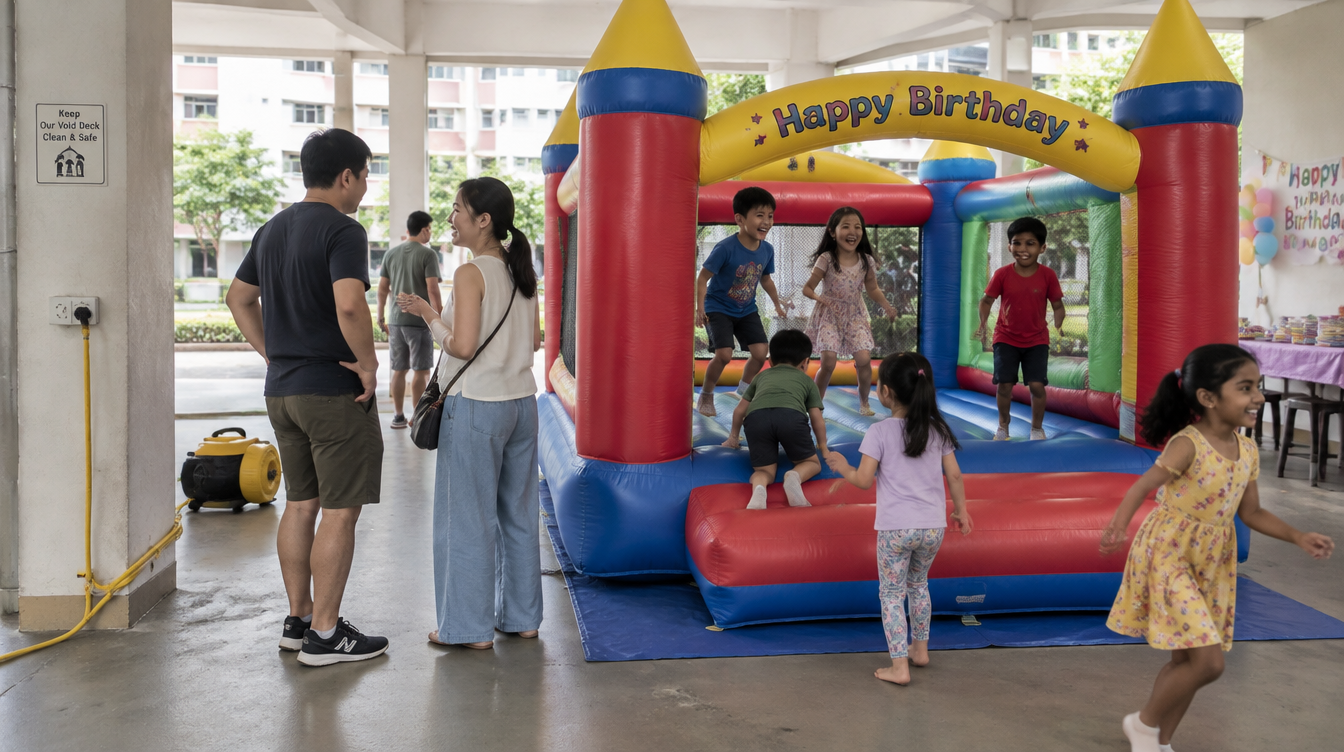
The bouncy castle arrives on time, the blower roars to life, and within minutes a dozen excited children are queuing at the entrance. Behind that happy scene sits something far less glamorous that decides whether the whole afternoon runs smoothly: where the power is coming from, and whether the cable reaching it is doing its job safely.
Most hosts spend weeks choosing a theme, a cake and a guest list, but power planning for your bouncy castle rarely comes up until the rental team asks about it on the day itself. A little planning here, done well before the event, saves a scramble that no one wants in front of a garden full of parents and children.
Why Power Is the Detail Most Hosts Forget
Bouncy castles, water slides and obstacle courses all rely on a blower that has to keep running for the entire session, not just at setup. Unlike a speaker system or a photo backdrop, the inflatable needs a continuous electrical supply the moment children start bouncing, because a lapse in power means a lapse in air and a rapidly sagging structure. That single requirement shapes almost every other decision about where an inflatable can go and how far its cable needs to reach.
Finding a Power Point Near Your Void Deck or Function Room
Most Singapore birthday parties happen at an HDB void deck or a condominium function room, and both usually have at least one accessible power point built into the space. The trick is confirming its exact location before booking day, not after the delivery team has already measured out the castle’s footprint.
Void decks vary a great deal in how their sockets are arranged. Some have a weatherproof point built into a pillar near the void deck management panel, while others route power through the nearest lift lobby or guard post, which can mean a much longer cable run than hosts expect. Condo function rooms tend to be more predictable, with sockets built into the walls for event use, though some management committees ask for advance notice before residents draw power for an outside vendor. A space guide for HDB void decks and condos covers how to measure floor space for the inflatable itself, and the same site visit is the right moment to also note where the nearest socket sits and how far it runs from where the castle will stand.
If no existing power point is within reasonable reach, say so when booking, not on the day. A rental provider forewarned about a longer cable run, or the need for a battery or generator backup, can plan for it properly instead of improvising.
What Your Bouncy Castle’s Blower Actually Needs
Once the socket is confirmed, it helps to know what the equipment itself requires so nothing short-circuits the afternoon, literally or otherwise:
- A dedicated power point rated for continuous use, not one already running a slow cooker or an urn for the buffet table.
- A cable long enough to reach the blower without being stretched taut or looped around sharp corners.
- A dry, clear spot for the blower itself, tucked out of the main play area since it keeps running throughout the session.
- A socket that isn’t shared with sound systems, bubble machines or lighting rigs drawing from the same circuit.
- A backup plan, such as a second point or a portable battery pack, for events expected to run several hours.
Extension Cords and Overloaded Sockets
The extension cord bridging the gap between the power point and the blower deserves as much attention as the socket it plugs into. It should be rated for continuous use, laid flat instead of coiled while in use, and kept clear of puddles if the event includes a water slide. The Singapore Civil Defence Force’s advice against overloading electrical outlets applies just as much to a garden party as it does to a kitchen, and a single extension cord carrying a blower, a sound system and a popcorn machine all at once is exactly the kind of load it warns against.
When There’s No Power Point in Reach: Parks, Beaches and Open Fields
Community events, grassroots carnivals and beach gatherings often take place far from any building, which means there is no wall socket to speak of. In these settings, a generator becomes part of the equipment list rather than an afterthought, and it needs its own clearance, usually set some distance from the inflatable for noise and fume reasons.
A generator sized correctly for one inflatable may not stretch far enough once a second unit, a PA system and festive lighting are added to the same event. This is one reason multi-inflatable setups for larger community days need the electrics sorted out earlier than a single-castle birthday party would, and organisers running a grassroots event should confirm with their rental provider exactly how many generators the day requires and where each one will sit relative to walkways, since a generator positioned awkwardly can become its own trip hazard among a crowd of children and elderly residents alike.
Fuel levels need the same attention. A generator that runs dry partway through an afternoon programme causes exactly the kind of sudden deflation that a continuous power supply is meant to prevent.
Water, Electricity and Keeping the Two Apart
Water slide inflatables raise the stakes slightly further, since splashing water and electrical equipment are never a good combination. Blowers, extension cords and power points for a water slide should sit well clear of the splash zone, ideally on a raised or covered spot that stays dry even as children run past dripping wet.
This is best raised with your rental provider at the planning stage, not discovered on the day, especially for void deck events where a water slide’s run-off has nowhere to drain quickly. A dry, well-placed power setup keeps the fun going without anyone needing to think about it again until pack-down.
None of this needs to fall on the host alone. A little advance information about your venue’s power points, and a clear-eyed look at what the day’s full line-up of equipment will draw, goes a long way toward an afternoon that runs as smoothly as the bouncing itself. If you would like help thinking through the electrics before your next event, feel free to get in touch and we will work through the details with you.