
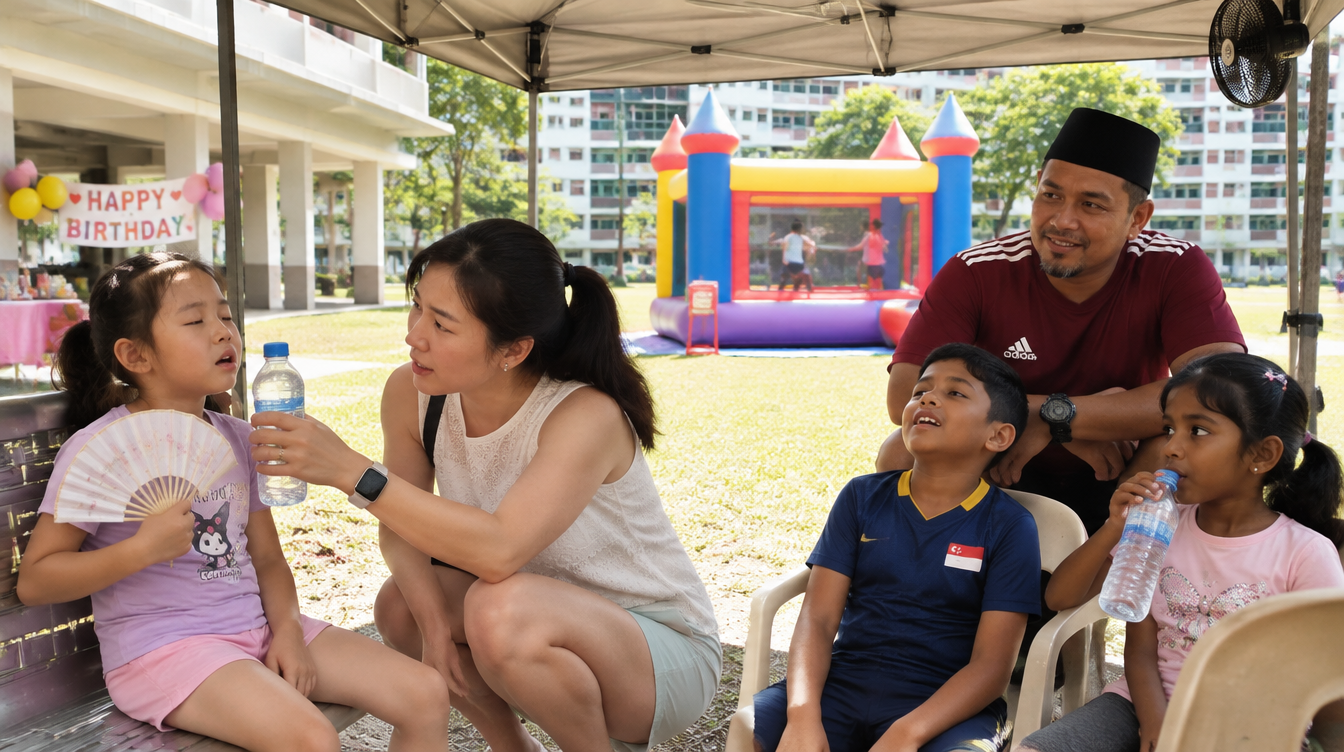
By half past ten on a clear Saturday morning, the tarmac beneath a freshly inflated bouncy castle can already feel noticeably warmer than the grass beside it, and the vinyl walls trap still more heat inside. Most Singapore hosts plan carefully for rain, booking an indoor backup or watching the forecast all week, yet the opposite weather extreme, a bright, cloudless morning, gets far less thought, even though it brings its own risks for children bouncing under direct sun for an hour or more.
Heat and sun exposure rarely make the same dramatic headlines as a sudden downpour, but they shape a bouncy castle event just as much. Getting the timing, shade and hydration right does not need to complicate the planning. It simply needs a different set of questions asked before the big day, and a few checks kept up once the children are inside.
Why a Bouncy Castle Heats Up Faster Than You Expect
An inflatable bouncy castle is built from PVC-coated fabric, typically in bright primary colours that absorb a good deal of solar radiation rather than reflecting it. Once the blower is running and the unit is fully upright, the air trapped inside barely circulates, and by midday the internal temperature of the castle can sit well above the air temperature outside it. Children moving energetically inside that enclosed space generate their own body heat on top of that, with none of the breeze they would get bouncing on an open field.
Singapore’s climate makes this more pressing than it would be in a temperate country. Ambient temperatures above thirty degrees are common through most of the year, and humidity keeps the body from cooling itself efficiently through sweat. A bouncy castle left in direct sun from late morning onward is rarely the coolest spot at any event, and hosts who assume shade is only an issue for seated guests often overlook the unit itself.
Reading the Conditions Before You Commit to a Start Time
Checking the day’s forecast is already a habit for most hosts when rain threatens, and the same habit applies just as well to heat and sun. Singapore’s National Environment Agency and the Ministry of Sustainability and the Environment jointly track a heat stress indicator reflecting how the body experiences temperature, humidity and sunlight together, a clearer picture than air temperature alone gives.
Sport Singapore applies a similar staged approach when deciding whether outdoor training and competitions should continue, pause or move indoors, built around rising bands of heat stress instead of one single cut-off point. The heat stress management plan for the sport fraternity sets out that staged thinking clearly, and the same underlying idea, that risk climbs gradually instead of switching on all at once, carries over neatly to a birthday party or a school carnival.
For most private events, the simplest version of this habit is choosing a start time before the sun is at its highest, somewhere in the late morning or early afternoon stretch, and building in a natural pause partway through instead of running one continuous session from start to finish.
Shade, Shifted Slots and Smarter Scheduling
Where the booking allows it, moving the bounce session earlier or later in the day does more for comfort than any single piece of equipment can. A pop-up canopy or event tent angled to shade the castle’s entrance keeps the queue out of direct sun even when the unit itself has to sit in an open, unshaded part of the field, and a quick check of where the sun will sit by midday, not only where it is at setup, helps decide which side that shade should go on.
Keeping Children Hydrated and Paced
Thirst is a late signal in children, who are often too absorbed in play to notice it building, so hydration works best as a scheduled habit instead of something only offered when a child asks for it. The importance of hydration during physical activity from ActiveSG Circle explains why regular small sips do more than one large drink after the fact, a principle that applies just as well to an hour of bouncing as it does to organised sport.
A water station is only useful if it gets used, which usually means stationing an adult near it instead of leaving a cooler unattended at the edge of the venue. Framing water breaks as part of the fun, a quick cool-down before the next turn, tends to work better than announcing them as a rule to be obeyed.
- Set up a water station within sight of the castle entrance, not tucked away at the back of the venue.
- Build a short break into every thirty to forty minutes of bouncing, even if nobody asks for one.
- Offer plain water instead of sugary drinks, which tend to leave children feeling warmer, not cooler.
- Encourage a seat in the shade between turns instead of queuing in direct sun the whole time.
- Keep younger children’s sessions shorter than older children’s, since smaller bodies heat up faster.
Spotting the Signs Before They Escalate
Most children recover quickly once they step off a bouncy castle and into the shade with a drink in hand, and nothing more serious comes of it. A small number of warning signs should be treated as a reason to stop a session early instead of waiting to see if they pass, particularly during the hottest stretch of the afternoon.
- A flushed, very red face paired with unusually heavy sweating or, just as tellingly, a sudden stop in sweating altogether.
- Complaints of headache, dizziness or nausea that do not ease within a few minutes of rest and water.
- Noticeable clumsiness, confusion or a child who seems unusually quiet after being energetic moments earlier.
- Cramping in the legs or stomach that appears without an obvious bump or fall to explain it.
Bringing the Wet-Weather Mindset to Hot Weather Too
Singapore hosts have become fairly disciplined about rain. Wet weather planning now sits firmly on most checklists, with indoor backups confirmed well before the day and void deck bookings treated as a serious contingency instead of an afterthought. The piece on wet weather planning for your outdoor event covers that side of the planning in detail, and much of its underlying logic, building a buffer into the schedule, confirming a backup in advance, checking conditions instead of assuming they will hold, applies just as directly to heat as it does to rain.
Treating sun and heat with the same seriousness need not cancel a single sunny booking. A shaded corner near the entrance, a water station someone is actually watching, and a start time chosen with the midday sun in mind, instead of only around when the venue happens to be free, cover most of what the day actually needs.
A shaded entrance, a water break built into the hour, and one adult keeping half an eye on flushed faces cost very little in planning and spare everyone an uncomfortable afternoon. If timing an outdoor booking around the day’s heat feels like one more thing to coordinate on top of everything else, our team is happy to talk it through when you get in touch about your event.