
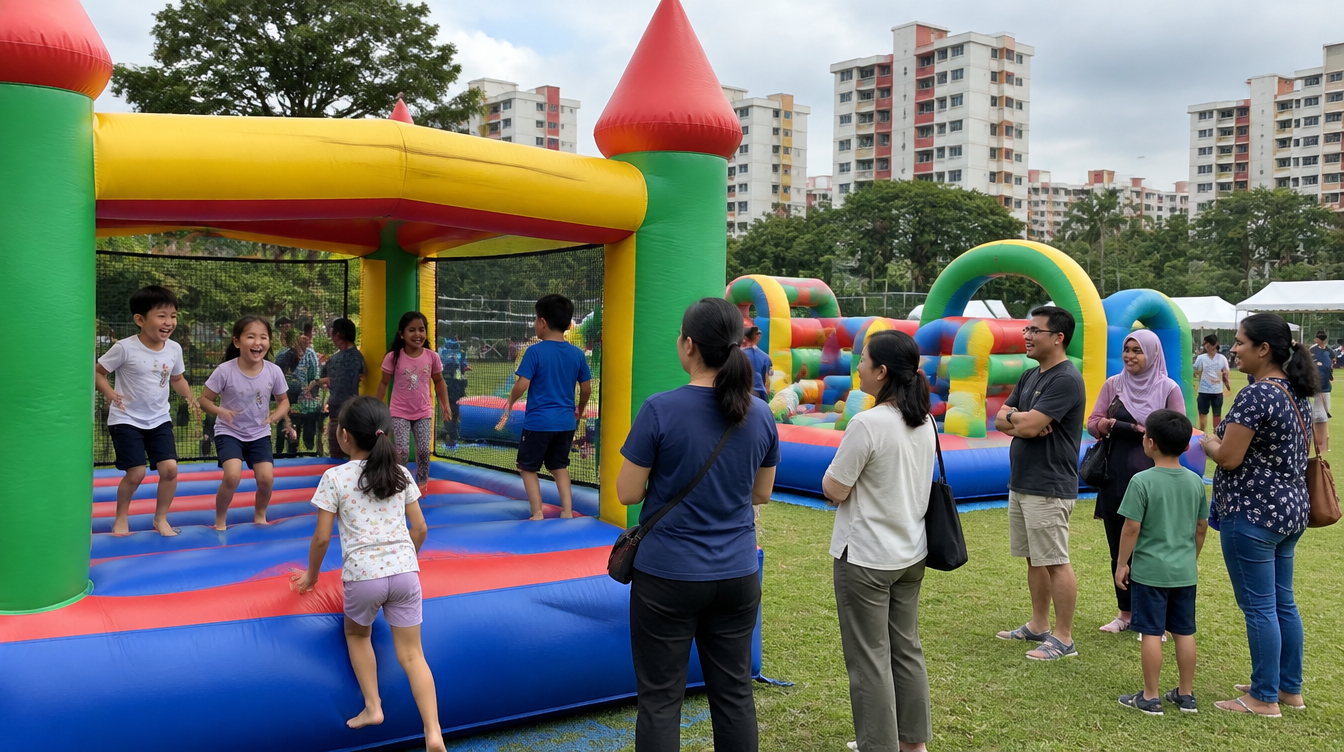
Picture a school field on a December morning, three inflatables already queued with excited children, and one harried teacher wondering whether the obstacle course or the bouncy castle should come down first for the class photo. Multiply the fun of a single unit by three or four and the logistics multiply too: more space to measure, more delivery windows to juggle, and more eyes needed on the bouncing all at once.
Corporate family days, school carnivals and larger community events increasingly call for multiple inflatables on the same afternoon, partly because a single bouncy castle cannot keep two hundred children entertained for three hours, and partly because pairing a bouncy castle with a water slide or an obstacle course simply gives an event more to talk about. Getting the combination right takes a little more planning than booking one unit, but none of it is complicated once you know what to look at first.
Why Bigger Events Need More Than One Inflatable
A single inflatable works well for a birthday party with twenty or thirty guests, but a school carnival with several hundred pupils moving through in shifts, or a corporate family day with staff and their children arriving across a whole Saturday, tends to outgrow one unit fairly quickly. Spreading guests across two or three inflatables shortens queues, lets organisers separate age groups naturally, and keeps the overall programme moving instead of stalling around a single attraction.
Mapping the Space Before You Book
The starting point for any multi-unit booking is the same question asked at a larger scale: how much clear, flat ground is actually available, and where. A bouncy castle, a water slide and an obstacle course each have a different footprint, and they need enough space between them for children to walk safely instead of cutting across an inflatable that is being packed down.
This is where void decks and community spaces in housing estates need a closer look than a single-castle booking would. Many HDB void decks and multi-purpose halls can comfortably host one inflatable, but fitting two or three means checking ceiling height, pillar spacing, and whether the space is shared with other residents during the booking window. HDB’s guide to community spaces sets out how these areas can be used and booked, a useful check to make early if the event is happening within a housing estate.
Outdoor venues such as school fields or park spaces usually have more room to play with, but they bring their own considerations: whether the ground is level and free of drains or slopes, whether there is shade nearby for parents supervising younger children, and whether a delivery lorry can realistically reach each set-up point without crossing walkways full of guests.
Getting the Sequencing Right on the Day
With one inflatable, the setup sequence is fairly linear: delivery, inflation, a safety check, and the unit is ready. With several units arriving for the same event, sequencing becomes the difference between a calm morning and a scramble. Staggering delivery times, instead of having every truck arrive at once, gives the setup crew room to position each inflatable properly and run individual safety checks before guests are already queuing at the entrance.
The same logic that applies to a single booking, covered in our piece on the timeline from start to finish, scales up here: build in a buffer before doors open, confirm who is receiving each delivery, and agree in advance which unit gets priority attention if something needs adjusting on site. A written run sheet shared with the venue and the events team beforehand saves a great deal of back-and-forth on the day itself.
Keeping Every Unit Supervised
More inflatables also mean more points that need watching at once, so it helps to assign responsibility clearly instead of assuming supervision will simply happen on its own. A few roles worth confirming ahead of time:
- A named supervisor at each inflatable who can enforce age and weight guidelines and pause entry once a unit is full.
- Someone circulating between units to relieve individual supervisors for breaks without leaving any inflatable unattended.
- A single point of contact who can pause every inflatable quickly if the weather turns or a fault appears.
- A first-aid-trained staff member whose location is known to each supervisor, not only to the event organiser.
Planning Around Singapore’s Weather
Rain is the one variable no amount of planning can fully control, and it becomes more disruptive with several inflatables involved, since packing down one unit in a sudden downpour is manageable while packing down three at once is not. Checking NEA’s live rain area tracker in the days before the event, and again on the morning itself, gives organisers a realistic sense of whether the programme needs an earlier start or a shaded backup area.
A simple contingency plan, such as a covered hall on standby or an agreed point at which units are powered down, is far easier to brief everyone on in advance than to improvise once the sky darkens and a few hundred guests are already on site.
Matching Inflatables to the Age Groups on Site
Choosing which inflatables to combine is as much about the guest list as the venue, and a mix that works beautifully for one event can frustrate another:
- A classic bouncy castle suits younger children well and works nicely as the first stop near the entrance.
- An inflatable obstacle course tends to hold older primary-school children’s attention for longer stretches.
- A water slide inflatable fits naturally into outdoor daytime events where getting wet is part of the appeal.
- Positioning a water slide away from walkways reduces the chance of slippery patches spreading to dry areas.
- Grouping the higher-energy units together lets calmer activities such as games or craft tables sit at a comfortable distance.
- Leaving extra space around the obstacle course gives queuing children room to watch without crowding the exit.
Timing It Around December and Year-End Events
September and October are when many schools and companies start locking in dates for the year’s biggest event days, and December’s school holidays alongside the run of year-end corporate D&Ds create a real peak in demand for larger inflatable set-ups. Booking two or three units together during this window naturally needs more lead time than a single castle for a Saturday birthday party.
Corporate family days in particular tend to land on similar weekends across November and December as companies wrap up the year, which means the inflatables and the crews needed to set them up safely get booked out early. Confirming numbers, the venue layout and a rain contingency a few months ahead, rather than a few weeks, leaves far more room to secure the combination of units an event actually wants.
None of this needs to feel like over-preparation. A carnival or family day with several inflatables is still, at heart, the same event as a single-castle birthday party, just with a few more moving parts to line up beforehand so the day itself runs the way it looked on paper.
Ready for a Bigger Event Day?
A school carnival, corporate family day or community event with more than one inflatable can run just as smoothly as a single booking once the space, sequencing and supervision are planned properly. If a bigger day is on the calendar, get in touch with BouncyCastle.sg to talk through which combination of inflatables would suit the venue and the guest list.