
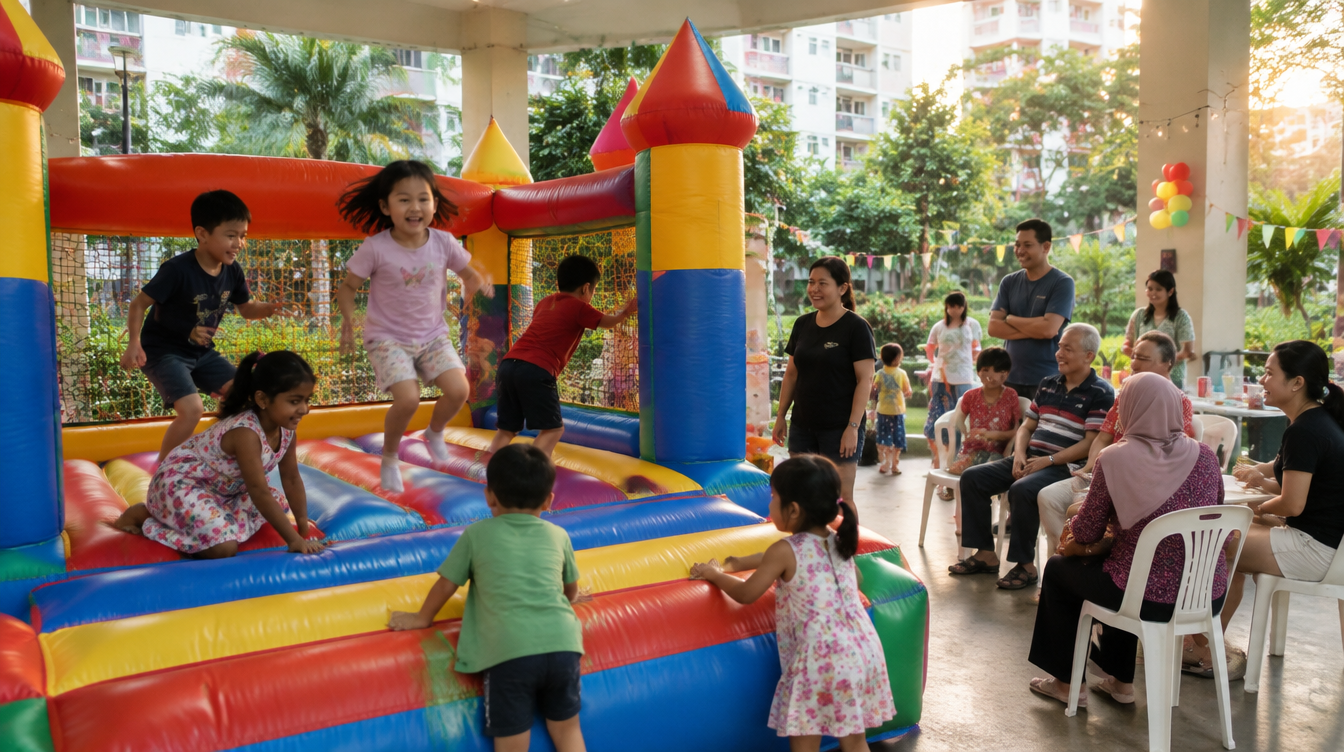
The message lands in almost the same words every year, usually sometime in November: “So sorry, we’re fully booked for that Saturday.” By the time it arrives, the host has often already guessed what’s coming, because half of Singapore seems to have had the same idea for the same weekend.
December squeezes an unusual amount of celebrating into a short stretch of the calendar. School holidays begin, families plan year-end parties, companies run their family days and dinner-and-dance events, and grassroots groups mark the close of the year, frequently within the same few weekends. Hosts who want to book a bouncy castle for December, or a water slide or inflatable obstacle course for that matter, are generally better off starting the process months rather than weeks ahead. A little forward planning at this point in the year makes the rest of the process considerably less stressful.
When Everyone Has the Same Idea at Once
Singapore doesn’t have a long December. School holidays begin in the first half of the month, close to the dates set out in MOE’s school terms and holidays for 2026, and the year winds down not long after. That means every kind of year-end event, birthday parties that happen to land in that window, school carnivals held before term ends, community celebrations and corporate family days, gets compressed into roughly six weeks. Demand for equipment and setup crews rises accordingly, and it rises fastest for the dates people want most: the first two weekends of the school holidays, and anything close to Christmas itself.
Vendors don’t add to their fleet of inflatables just because December has arrived. The number of bouncy castles, water slides and obstacle courses available on a given Saturday is roughly the same as it is in March. Far more people simply want one on that particular date, and the same handful of popular afternoons get requested again and again.
The Singapore December Diary, Compacted Into Six Weeks
A useful way to picture why December fills up is to list who’s actually competing for the same weekends. On any given Saturday in the first half of the month, an event organiser might be trying to book equipment for:
- school holiday birthday parties and family gatherings, clustered around the first weeks off
- corporate dinner-and-dance events and family days, often scheduled before staff take year-end leave
- community and grassroots celebrations marking the close of the year
- Christmas and year-end gatherings for extended family, condos or interest groups
How Many Weeks’ Notice Is Realistic
There’s no single figure that applies to every event, but a sensible rule of thumb for December is to start enquiring as soon as a date is even loosely fixed, ideally by September or early October. That gives enough runway to secure a popular Saturday before it disappears from the calendar entirely, and it leaves room to adjust if a first-choice date turns out to be unavailable.
Weekday slots tend to stay open longer, since most families and schools naturally gravitate towards weekends. A corporate event booked for a Friday afternoon, or a community event scheduled on a weekday during the school holidays, often has more flexibility even into November. Weekend afternoons in the first two weeks of December are the tightest of all, particularly for larger events that need more than one inflatable, since coordinating several units for a single site adds another layer of scheduling. Hosts planning anything of that scale do well to treat early booking as part of the planning itself, not an afterthought tacked on at the end.
None of this means a booking made in November is doomed. It simply means the choice of dates and equipment narrows considerably the longer a host waits, and the most popular combinations tend to go first, sometimes weeks before anyone official has even announced that December is officially “busy.”
What to Have Ready Before You Call
Booking early works best when the enquiry itself is specific. A vague request for “a bouncy castle sometime in December” takes longer to match to available equipment than one that already has the practical details worked out, and it can mean losing a date to someone who called with a clearer picture.
- the exact date and preferred time window for setup and collection
- the venue, whether that’s a void deck, a condo function room, a school field or a park
- roughly how many children or guests are expected, and their age range
- whether the space is indoor or outdoor, and what the surface is like
- any known restrictions on noise, access or setup hours at the venue
If you haven’t already worked through everything you need to check for your specific venue, do that before the call instead of during it, since most providers ask for these details early on to confirm what will actually fit and set up safely on the day.
Locking In the Date That Works
Once a date is confirmed, it’s generally held once a deposit or agreement is in place, which is why acting on availability quickly makes a bigger difference in December than in any other month. A host who enquires in September with a flexible date and a clear venue is in a far stronger position than one who calls in late November hoping for a Saturday that dozens of other people wanted too. School terms for the year ahead are usually confirmed well in advance, so there’s rarely a good reason to wait until the holidays are officially announced before making a first enquiry of your own.
December will fill up whether a host starts planning in September or waits until the last fortnight; the only real choice is which side of that calendar they end up on. Whatever the occasion, a birthday party, a school carnival, a corporate family day or a community gathering, getting the date and equipment settled early tends to make everything that follows far calmer. If you have a December event on the cards, feel free to get in touch and we’ll help you work out what’s realistic for your timeline.