
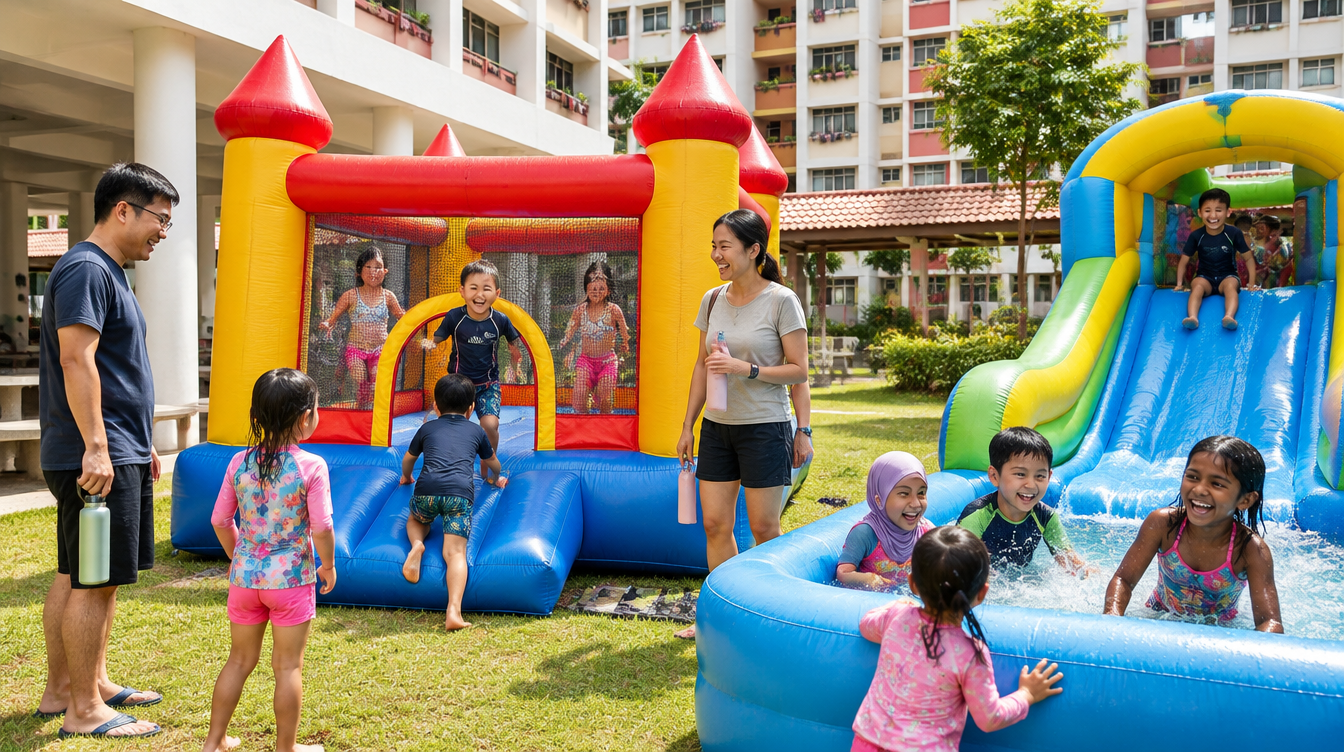
Ask a Singapore parent which stretch of the year tests their event-planning stamina hardest, and plenty will point past December to the June school holidays. Four straight weeks of children home from school, a string of play-dates that somehow all land on the same two Saturdays, and a calendar that fills up faster than anyone expects.
For hosts weighing up a bouncy castle, a water slide inflatable or an obstacle course for a birthday, a school event or a community gathering, the June school holidays bring a second booking rush that catches almost as many people off guard as the one in December, just for different reasons. The December rush is driven by year-end parties, corporate events and a packed festive calendar all landing in the same few weeks. June is quieter on the surface, but with four weeks of school-free Saturdays to choose from, more families end up reaching for the same handful of dates than most hosts expect. Knowing what drives that rush, and when to lock in a date, makes the difference between getting the Saturday you want and settling for whatever is left.
A Four-Week Window, Not Just One Weekend
The mid-year break typically runs for around four weeks, stretching from the tail end of May through most of June before term three begins, a length families can check each year on the Ministry of Education’s school terms and holidays page. That is roughly double the December break most hosts already plan around, and because it falls in one unbroken stretch, rather than being split by a public holiday the way some shorter breaks are, families tend to settle on dates early and fill the first and last weekends of the window fastest.
Why the Heat Tips the Balance Toward Water
June sits within Singapore’s south-west monsoon period, when the National Environment Agency’s forecasts typically point to warmer, drier stretches between spells of rain. For a host planning an outdoor event in the middle of the day, that heat often tips the choice between a bouncy castle on its own and pairing it with a water slide inflatable, since a cooling splash does more to keep a mixed-age group comfortable through a long afternoon than shade alone.
Anyone adding a water slide to the day should run through the safety checklist for hosts beforehand, since supervision and sun exposure both need a slightly different plan once water is involved. The extra planning is modest, and having it in place before the water slide is filled keeps the afternoon running smoothly, since children are outdoors and active for longer stretches at a time.
The Dates That Fill First
Not every day within the four-week window books up at the same pace. A handful of patterns repeat year after year, and hosts who know them can time their enquiry before the obvious choices disappear:
- The first Saturday after school breaks up, when relief at reaching the holidays turns straight into party planning.
- Weekends that fall close to a public holiday, when extended families use the long stretch to combine visits with a celebration.
- The final weekend before term three begins, often treated as one last gathering before routines return.
- Weekday mornings, which free up once camps and enrichment classes run their course partway through the break, and tend to be the easiest slots to still find close to the holidays.
Fitting One Event Around Many Calendars
A four-week break also means more competing claims on a child’s time than a single long weekend ever brings. Overseas trips, grandparents visiting from out of town, school holiday camps and quieter weeks spent simply catching up on sleep all draw from the same stretch of dates, so a date that looks wide open in May can be surprisingly full by the time June arrives. Some families only settle their travel plans a few weeks ahead, which means a Saturday that seemed free when the calendar invite first went out can quietly disappear by the time everyone replies.
Where several families want to combine a celebration, whether that is cousins sharing a joint birthday or a few households pooling resources for a bigger setup, agreeing on a date even a week or two before the holidays start gives everyone enough notice to keep that date free, instead of trying to coordinate once the holidays are already underway and calendars have filled.
What to Confirm With Your Rental Provider Early
Once a date is set, a short round of practical checks saves last-minute surprises on the day itself. Before confirming a booking, it helps to have answers ready on:
- The exact floor space available, measured precisely, not estimated, since bouncy castles and obstacle courses both need clearance well beyond their footprint.
- Whether the surface is grass, concrete, tiles or an indoor floor, since each affects how the unit is anchored or weighted down.
- The route from the loading area to the event space, including lifts, stairs or a loading bay if the venue is a high-rise building.
- A nearby, dedicated power point, not one already shared with speakers, fans or catering equipment.
- The weather forecast for the date itself, with a simple contingency in mind if rain is likely.
- Preferred setup and collection times, so the equipment is ready well before guests arrive and cleared without rushing the pack-down.
A date locked in early, with the space, power and weather all checked off beforehand, tends to make for the easiest kind of event day: one where the only surprise is how fast four weeks of holiday time go. The planning itself does not need to take long, and most of it comes down to asking the right questions before the calendar fills up around you. If a date in this stretch of the calendar is calling for a bouncy castle, water slide inflatable or obstacle course, get in touch and our team can help plan the setup around it.