
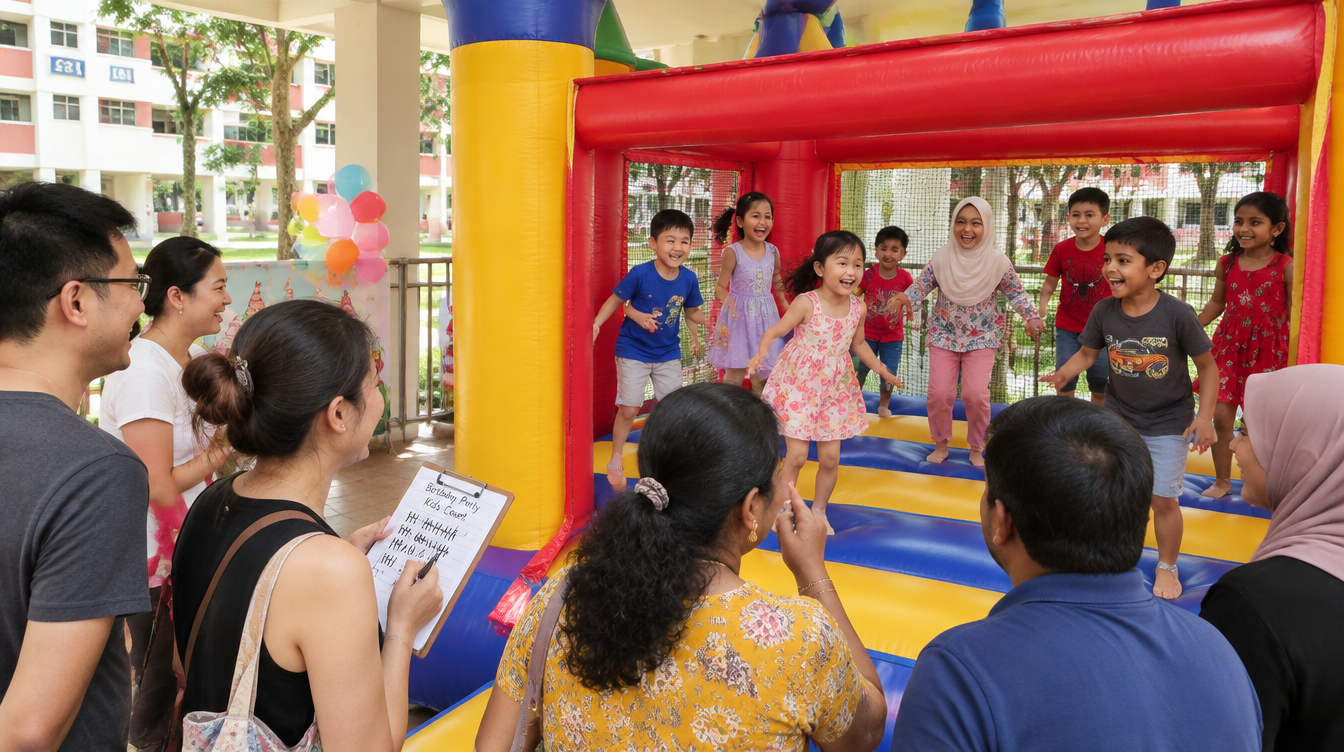
A parent doing a headcount at a birthday party rarely stops to ask whether the bouncy castle itself has a headcount of its own. Yet tucked into the stitching of every inflatable, usually near the entrance, is a small label with a number on it: a maximum user count, a maximum combined weight, or both. Most guests never read it, and most hosts only think about it once the unit already looks fuller than it should.
That number is not a suggestion. It reflects how the manufacturer tested the fabric, the seams and the blower that keeps the whole structure standing, and it changes depending on the size and design of the unit booked. Understanding what it means, and how to keep an eye on it once the party is in full swing, is a small piece of planning that makes a real difference to how safely the day goes.
The Number Printed Inside Every Unit
Every bouncy castle, water slide inflatable and inflatable obstacle course is built to a specific load tolerance, set by the manufacturer and usually displayed on a safety label somewhere near the entrance. That figure is not arbitrary. It accounts for the strength of the seams, the capacity of the blower keeping air pressure stable, and how the unit behaves when weight shifts suddenly from one side to another, which is exactly what happens when a group of children jump.
Two units that look almost identical in photos can carry very different limits. A compact castle built for toddlers might be rated for four or five small children at a time, while a larger multi-play unit built for primary schoolers could comfortably hold eight or more. Checking the actual number for the unit booked, instead of assuming a size based on how big it looks once inflated, is the first step toward using it safely.
Weight Limits Versus a Simple Headcount
Capacity is not just about counting heads. A unit rated for a certain number of users typically assumes an average child weight for the age group it is designed for, so a handful of older, heavier children can reach that same weight limit well before the headcount does. A few practical factors shape how that number plays out on the day:
- The physical size of the inflatable and how its play area is divided into separate sections or zones
- The blower’s output, since reduced air pressure under load changes how the surface responds to weight
- How evenly children are spread across the bounce area instead of clustering in one corner
- The condition of the anchoring points, which becomes more important when a unit is carrying closer to its rated maximum
When Age Groups Share the Same Unit
None of this needs a tape measure or a calculator on the day. It simply means treating the printed number as a weight ceiling as much as a people ceiling, especially when older children and much younger siblings end up on the same unit together, which happens often at Singapore parties where cousins, siblings and friends from different classes all end up on the same inflatable at the same time. An inflatable rated for six primary schoolers is not necessarily safe for six primary schoolers plus three younger siblings who wandered in during a quiet moment.
The simplest way around this is to treat age-mixed groups as using up capacity faster than a single age band would, rather than applying the headcount number literally regardless of who is actually bouncing.
A supervising adult near the entrance, even an informal one, tends to catch this naturally. Someone watching the flow of children in and out can judge when a unit looks genuinely full instead of relying on a mental count that gets harder to keep accurate once excitement takes over. The same logic behind inflatable obstacle course safety applies here too, since a crowded obstacle run carries the same weight-distribution risk as an overfull bounce area.
What Overloading Actually Looks Like
An overloaded unit rarely collapses dramatically. What usually happens first is more subtle: the floor feels softer underfoot, the walls lean slightly inward, and children bouncing near the edges start landing at odd angles because the surface is no longer behaving the way it was designed to. The UK’s Royal Society for the Prevention of Accidents has pointed to overcrowding and mixed age groups as recurring factors in inflatable-related injuries, which lines up with what most experienced operators notice on site long before anything looks obviously wrong.
Building a Capacity Check Into the Event Day
None of this needs to feel like a safety lecture delivered to excited eight-year-olds. A few small habits, repeated consistently through the afternoon, do most of the work on their own.
It helps to agree on a rough number before the party starts, so whoever is watching the entrance has a figure in mind instead of guessing in the moment. Pairing that with a natural pause between groups, the kind that already happens when one set of children climbs off and another climbs on, gives a host an easy point to recount heads instead of waiting for the unit to visibly fill up. A handful of habits make this easier to sustain over a long afternoon:
- Note the manufacturer’s maximum user count before guests arrive, not after the first group is already inside
- Rotate groups at natural breaks instead of letting numbers build up gradually over the afternoon
- Separate much younger siblings from older children where the unit allows for it
- Keep an eye on the anchoring points if the unit is holding close to its rated maximum for any length of time
- Ask the delivery or setup team directly if the printed number is unclear or hard to find
- Treat a noticeably softer or less stable floor as a sign to pause and thin the group out
A properly sized, well-maintained inflatable and a host who keeps half an eye on how full it looks will cover most of what a party actually needs. Getting the number right from the start means nobody has to make an awkward call mid-afternoon about asking a few children to wait their turn.
Working out the right inflatable size for your guest list, and keeping an eye on it once the party gets going, is exactly the kind of detail our team helps hosts plan for ahead of time. If you are weighing up options for an upcoming event, feel free to get in touch and we can talk through what will suit your space and your guest list.