
A school carnival that runs across a Friday and Saturday, a corporate D&D weekend with a family segment the next morning, a community festival stretching from a Saturday afternoon into Sunday evening: multi-day events have become a familiar fixture on the Singapore calendar, and the planning for them usually stops at the first day’s run sheet. Few hosts give much thought to what happens to the bouncy castle once the last child has gone home and the void deck or field falls quiet for the night.
That gap is easy to overlook, and it shapes how the second day starts. An inflatable left without a plan between sessions is exposed to dew, shifting wind, curious passers-by and the occasional unlocked gate, and a unit that looked perfect on day one can start the second day with a soggy base, a loosened anchor point or a muddy footprint tracked in from overnight rain. A little overnight care closes that gap, and it takes far less effort than most hosts expect.
Why Multi-Day Events Change the Care Routine
A single-afternoon party is simple by comparison: the castle goes up, the party runs its course, and the rental team deflates and loads it onto the lorry before dinner. A multi-day booking removes that clean end point. The unit has to survive the hours in between, whether that means an overnight gap at an HDB void deck with no gate to lock, a school field open to anyone walking a dog after dark, or a function room that technically closes but still sees cleaning staff moving through it until midnight.
Deciding Whether to Deflate Overnight
The first decision, and usually the most consequential one, is whether the castle stays inflated through the night or comes down between sessions. For an outdoor setting, deflating is almost always the safer default. A flat, covered unit is not catching wind the way an inflated one is, and it is far less tempting to anyone who might otherwise climb on or over it after hours.
A few signs make that choice straightforward instead of a judgement call. Consider deflating overnight when any of the following apply:
- The setup is outdoors and exposed, without walls, an awning or a roof overhead.
- The forecast for the night ahead mentions wind gusts or thundery showers.
- There is no lockable gate, fence or controlled access around the site.
- More than about twelve hours will pass before the next session begins.
An indoor hall with a locked door and no weather exposure is the one setting where staying inflated overnight sometimes makes sense, usually because deflating and reinflating adds more risk of a rushed setup the next morning than it removes. Even then, raise it with the rental provider at the time of booking, not on the night itself, since not every unit or venue suits a long, continuous inflation.
Weatherproofing Between Sessions
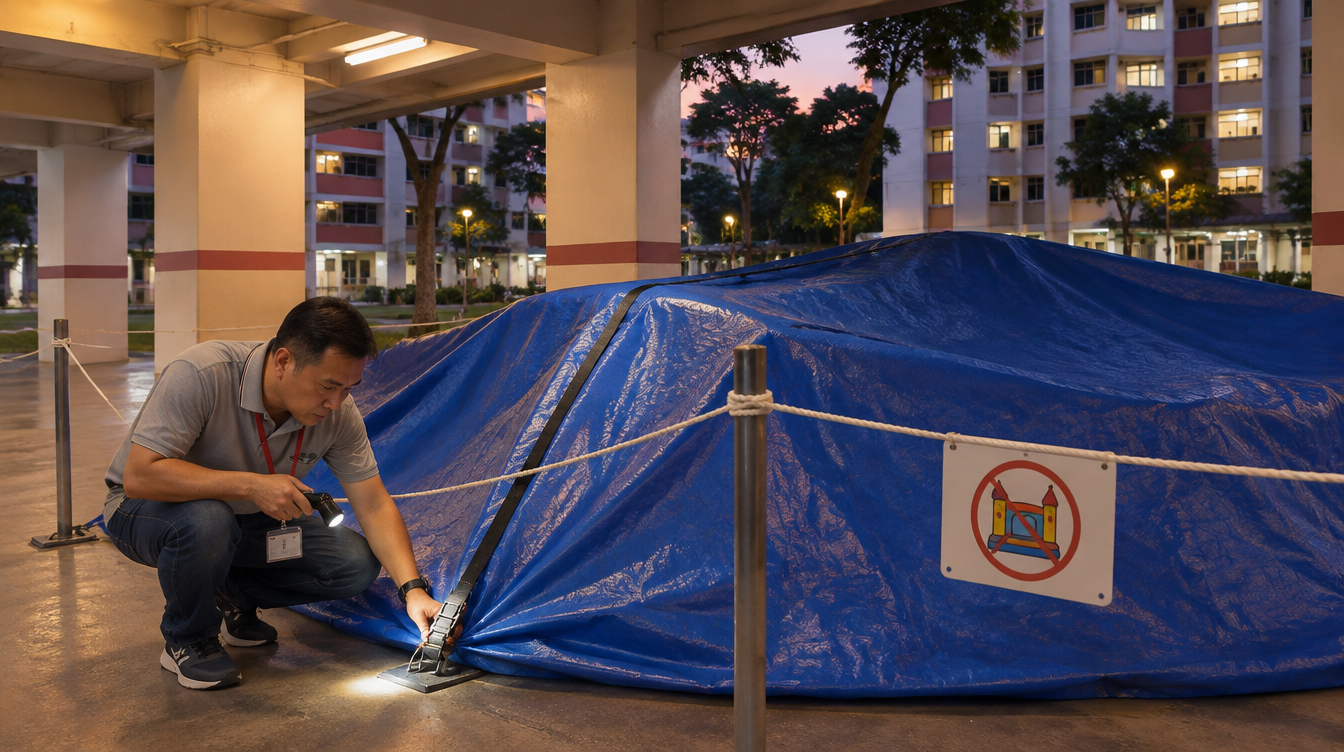
Even a deflated castle benefits from a weatherproof cover overnight. Singapore’s humidity means dew settles on exposed fabric within a couple of hours after dark, and a folded, uncovered unit can trap that moisture in its seams by morning, leaving a faint mustiness that takes a full day of airing to shift. A simple tarp, cinched down at the edges and not left loose, keeps the fabric dry and the folds from gathering standing water if a shower passes through overnight.
Checking the overnight forecast before deciding how much reinforcement that cover needs takes only a minute and settles the question quickly. Our piece on wind and lightning safety covers how to read live conditions once an event is under way, and the same habit applies the evening before a second day: a forecast showing stronger overnight gusts is a reason to add extra tie-downs or weighted sandbags to the cover itself, not just to the castle’s usual anchor points.
Keeping the Site Secure Overnight
Keeping the site secure overnight deserves the same attention as weatherproofing, particularly at an HDB void deck or open field where anyone can walk through after dark. A simple cordon of rope or tape around the covered unit, paired with a small sign asking people to keep clear, does most of the work on its own. It also helps to let the venue’s night security patrol or the estate’s regular rounds know that equipment will be sitting there overnight, since a quiet word in advance means a passing guard glances over instead of walking past without a second thought. The blower itself should always be switched off and unplugged overnight, never left running or merely idle at the socket, both to save on the power bill and to avoid leaving a live connection unattended near HDB corridors that residents walk through at all hours.
Starting Again the Next Morning
Treat the next morning as a fresh setup rather than a simple continuation of day one. A short check before reinflating catches most of the small problems an overnight gap can leave behind, and it takes only a few minutes longer than skipping straight to the blower switch. Work through it in roughly this order:
- Remove the cover fully before touching anything underneath it.
- Check for pooled water in the folds and let it drain or dry before reinflating.
- Inspect every anchor point and tie-down for slackness or movement overnight.
- Clear away any leaves, branches or litter that may have blown in.
- Run a quick visual check along the seams and base for anything that looks different from the evening before.
- Confirm the landing area is still clear before switching the blower back on.
Once that check is done, reinflate at the same unhurried pace used on the first day. Treating the second morning as its own small setup, not an afterthought, is usually what separates a multi-day event that runs smoothly from one that starts the second day with an avoidable scramble.
Multi-day bookings are not something most hosts plan around in detail until the schedule is already set, so it helps to mention the overnight gap when you first book. If you’re planning a carnival, D&D weekend or community event that runs across more than one day, get in touch and we’ll work through the setup, the hours in between and the next-morning timeline together.