
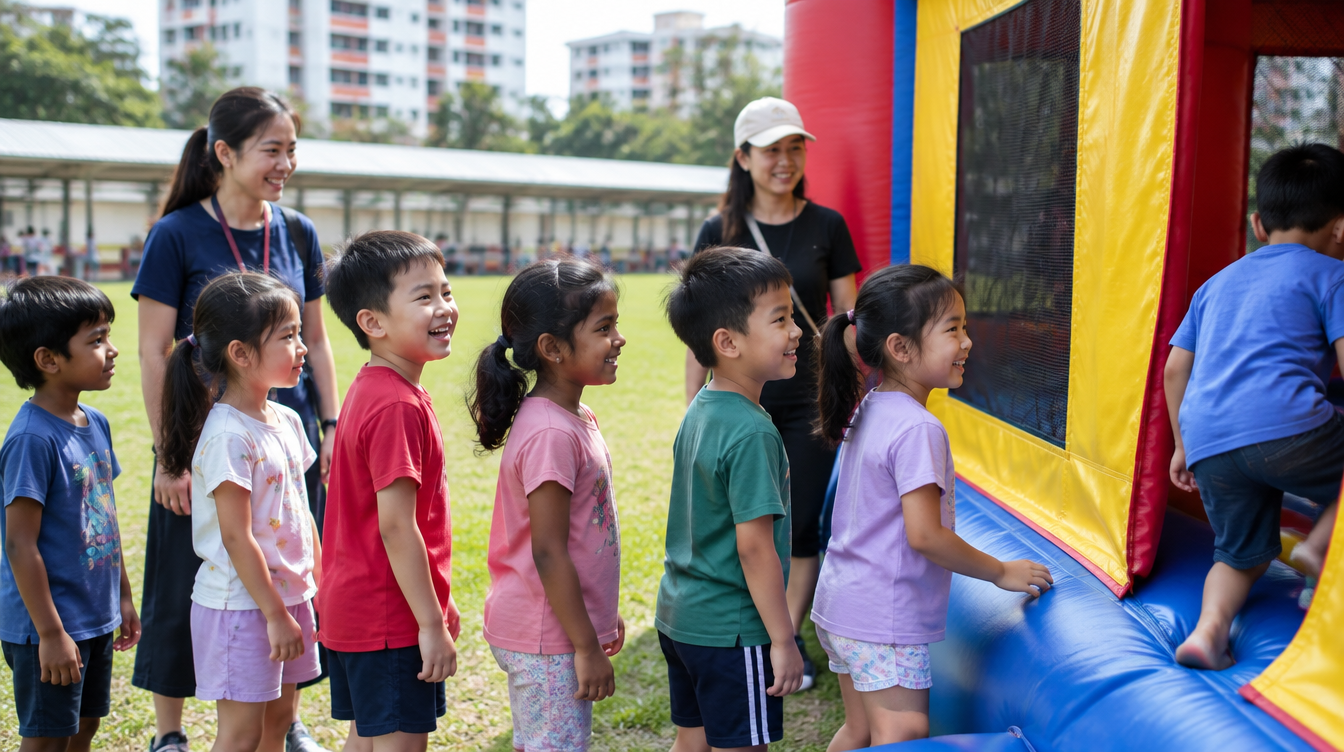
Nothing turns a school field into a festival quite like the moment the inflatables go up, fabric castles rising in primary colours while pupils cluster at the fence counting down to the recess bell. A school carnival multiplies that energy across an entire cohort, and getting the inflatable line-up right takes a different kind of planning to a single birthday party in someone’s garden.
Whether it is organised by the parent support group, the co-curricular office, or a joint committee of both, a carnival brings together hundreds of children spanning several age groups, several hours of programme, and a school compound that was never designed with giant inflatables in mind. Getting the choices right, from what to book to where it goes, makes the difference between a smooth celebration and a logistics headache for the teachers on duty.
Why School Carnivals Need Their Own Playbook
A birthday party usually means one inflatable, one age group and a garden or function room the host already knows well. A school carnival is a different animal altogether: the crowd includes six-year-olds and twelve-year-olds queueing at the same time, the venue is shared with other stalls and performances running simultaneously, and the people supervising are teachers and parent volunteers, not a single host keeping an eye on things. Treating a carnival booking the same way as a birthday one is usually where the timeline starts to slip.
Matching Inflatables to a Whole-School Crowd
For the youngest pupils, a classic bouncy castle remains the safest and most reliable choice. Lower primary children respond well to open bounce space instead of obstacles to navigate, and the gentler pace suits classes that are only given a short slot before rotating to the next activity.
Upper primary and secondary pupils tend to get more out of an inflatable obstacle course, which gives them something to race a friend on instead of simply bouncing on the spot. The timed, competitive format also helps a carnival committee move larger groups through in a fixed number of minutes, which matters when an entire level is scheduled into the same half-hour block.
Larger carnivals with pupils spread across several levels often need more than one inflatable running at once just to keep queues manageable. Coordinating multiple inflatables for bigger events involves working out separate power points, a wider safety perimeter between units and enough marshals to keep each queue moving, so it pays to think through the layout before the booking is confirmed rather than on the morning itself.
Space and Compound Constraints on the Day
Most Singapore schools run their carnival on the field, the covered basketball court, or occasionally the hall if the event doubles as a rain contingency. Each space comes with its own limits: a field gives the most room but exposes the inflatable to full sun and wind, a covered court offers shade but usually has a lower and narrower footprint than it first appears, and an indoor hall needs enough ceiling clearance for a bouncy castle to be inflated safely without brushing overhead fittings.
Whichever space is chosen, the inflatable needs a clear buffer on every side, generally at least a metre beyond the unit itself, so pupils queueing or wandering between stalls do not collide with the structure while it is in motion. It helps to walk the compound with the rental team ahead of the event to confirm access for the delivery vehicle, the nearest power point, and whether any other stall will end up too close once everything is set up.
Getting the Layout and Timing Right
A carnival committee usually has one chance to get the floor plan right, since changes on the morning itself are disruptive once other stalls have already claimed their spots. A short planning checklist, worked through with the rental provider a few weeks ahead, tends to save the most last-minute scrambling:
- Confirmed headcount and age spread for each time slot, so the right inflatable is booked for the right group
- A ground surface check, since grass, synthetic turf and hard court each need different anchoring
- The power point location and cable run, kept well clear of walkways
- A rain contingency space already agreed with the school, not decided on the day
- A named staff member or parent volunteer responsible for each inflatable’s queue
Managing the Day: Queues, Supervision and Handover
Instead of opening every inflatable to the whole school at once, most carnivals run a rotation, giving each level or house group a fixed window before moving on to the next station. This keeps numbers at any one inflatable to a manageable size and gives teachers a natural cue to shepherd their class onward once the slot ends.
The rental team will brief whoever is stationed at each inflatable on the basics: shoes off, no glasses or sharp accessories inside, and a sensible cap on how many pupils bounce together at once. A queue moves faster when the same volunteer stays at that post for the full session, instead of a rotating cast of helpers.
Once the last scheduled slot ends, deflation and pack-down usually take fifteen to twenty minutes, so building that gap into the schedule avoids the space being needed before it is actually clear. A quick walk-through with the rental team at handover, checking the ground underneath and confirming nothing was left behind, closes out the booking cleanly.
Weather Contingency for an Outdoor Carnival
Singapore’s daytime heat is rarely far from mind when an event runs for several hours outdoors, and school carnivals are no exception given how much of the programme has pupils standing in open queues. The NEA’s heat stress advisory for outdoor activities in Singapore is a useful reference for gauging when extra water points, shaded waiting areas or shorter rotation slots should be built into the schedule.
If the forecast looks doubtful, having a covered court or hall already agreed as a fallback, as covered earlier, means the carnival can shift indoors without pupils losing their turn altogether. Confirming that backup space with the school well in advance, instead of leaving it as a same-day decision, keeps the change smooth if the rain does arrive.
Carnival day asks a lot of the people organising it, and the inflatable line-up is often the part pupils remember longest. With the right units chosen for the right age groups, a floor plan that respects the compound’s limits, and a team briefed on the day’s rotation, that part of the programme can run itself while everyone else focuses on the rest of the day. If your committee would like a hand thinking through the layout for your school’s event, feel free to get in touch and we can talk through what would work best for your compound and headcount.