
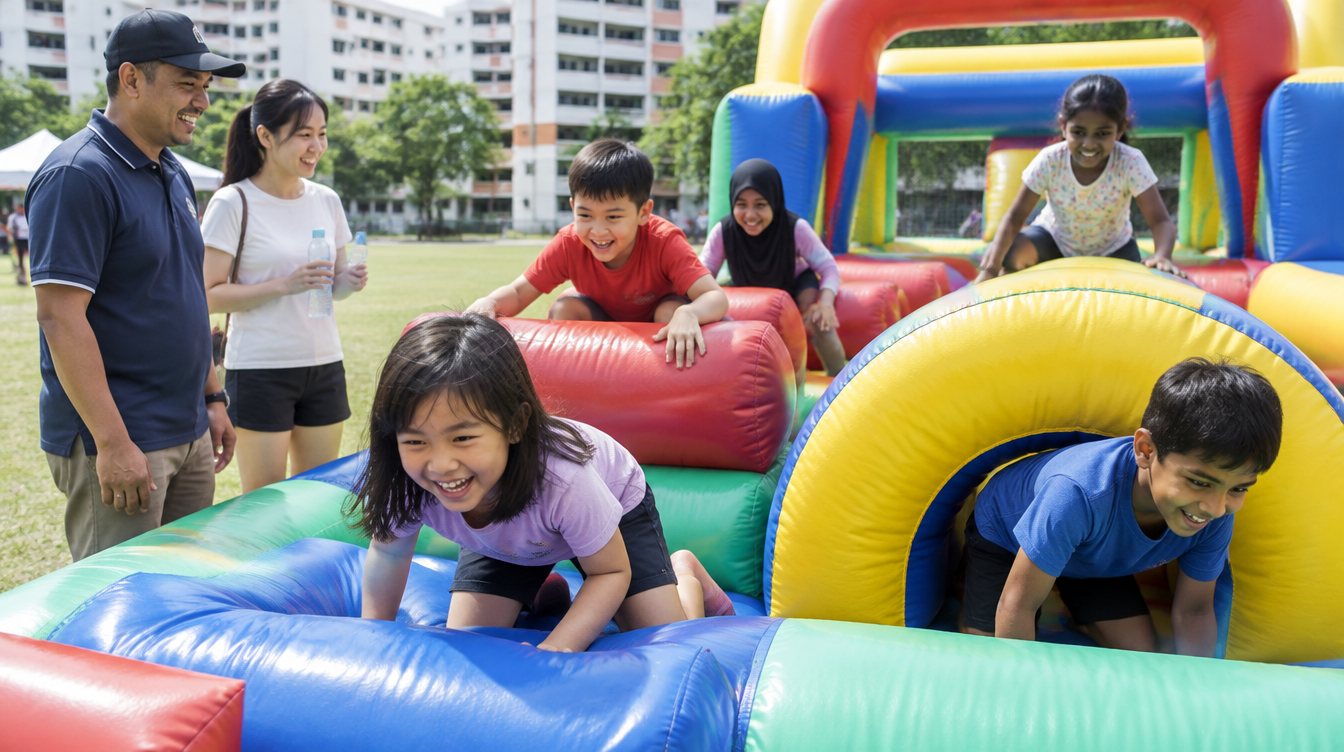
Picture an inflatable obstacle course set up across a school field on a Saturday morning: a tunnel to crawl through, a wall to scale, a soft landing at the end, and a queue of children bouncing on their toes waiting for a turn. It looks like straightforward fun, and for the most part it is. But an obstacle course asks a little more of a host than a standard bouncy castle does, simply because there is more happening inside it at any one time.
Good obstacle course safety starts well before the first child climbs in, and it does not stop once the equipment has passed inspection. It carries through into how the run is managed, how long each group spends inside, and when a break is called. Get that right, and the course becomes the part of the day everyone remembers for the right reasons.
Why an Obstacle Course Asks More of a Host
A bouncy castle is largely self-contained: children bounce in one enclosed space, and a single supervisor can usually see the whole thing at once. An obstacle course spreads children across tunnels, climbing sections and crawl-throughs that are not always visible from one vantage point, which changes what supervision actually needs to look like.
It also changes the pace of play. Where a bouncy castle lets children bounce at their own rhythm, an obstacle course is usually completed as a timed run, often with several children moving through different sections at once. That is a reasonable way to keep the queue moving, but it only works if someone is positioned to see each section and step in if a child gets stuck or two children reach a narrow point together.
None of this means an obstacle course is a riskier choice for a Singapore event. It simply needs a slightly different safety plan, built around supervision points and sensible group sizes, rather than treating it as a longer version of a bouncy castle.
Before the Children Climb In
A proper pre-event check for an inflatable obstacle course covers more ground than a quick walk-around. Because the course is a longer run of connected sections instead of one enclosed bounce area, each section needs its own look before anyone is allowed on.
- Anchor points and ground stakes at every section, not just the ends, since a long course gives the wind more places to catch it
- Clear space around the entire footprint, including the exit, so a child stepping off at speed does not land near a fence, pole or picnic mat
- Entry and exit points checked separately, since these are where most bottlenecks and trips happen
- A visual check of each tunnel and climbing section for tears, loose stitching or soft spots, not only the overall structure
- Current wind conditions checked against the manufacturer’s rated limit before setup is signed off
Keeping the Run Itself Under Control
Once the course is up and checked, the next safety question is how children actually move through it. Grouping children into small batches, spacing each batch a few seconds apart, and positioning a staff member at the narrowest point of the course all help prevent the pile-ups that cause most minor obstacle course injuries. It is a similar principle to the turn-taking approach covered in queues fair and safe at an event, just applied to a course instead of a single bounce area.
Age and size mixing deserves a practical look too: a course built for primary-school-aged children can usually handle a confident six-year-old and a cautious ten-year-old in the same batch, but putting a toddler through with much older, faster-moving children in the same run is where most near-misses happen. A quick visual sort before each batch goes in works better in practice than a strict age cut-off.
Heat, Hydration and Knowing When to Call a Break
An obstacle course is more physically demanding than sitting or bouncing in place, and Singapore’s heat makes that worth planning for directly. Crawling, climbing and scrambling through a course for several minutes at a stretch raises a child’s exertion level quickly, especially in direct midday sun.
A sensible approach is to check Singapore’s Heat Stress Advisory before an outdoor session, particularly for a longer event running through the hottest part of the day, and to build in water breaks between batches, not only at the end. NEA and MSE’s advisory gives three risk levels based on real-time conditions, with guidance on adjusting outdoor activity at each one, which is a useful reference when deciding how long a session should run.
A water point near the exit and a staff member keeping half an eye on conditions cover most of what is needed, with a shorter session on a hot afternoon as the simple fallback.
Matching the Course to Who’s Playing
The safety plan for an obstacle course also shifts depending on the event. A school carnival with mixed age groups benefits from clearer batch sorting and a teacher stationed at the entrance, while a corporate family day with mostly accompanied children can run slightly larger batches since parents are often already nearby to help. A community event with a wide age range sits somewhere in between, and usually benefits from two supervision points instead of one.
An inflatable obstacle course adds a layer of energy to any event that a bouncy castle alone does not quite match, and with sensible checks and a clear run plan, that energy stays firmly on the fun side of the day.
If you are weighing up an obstacle course against other inflatables for your next event in Singapore, our team can help you work out what suits your venue, age group and timeline. Feel free to get in touch and we will talk through the options together.