
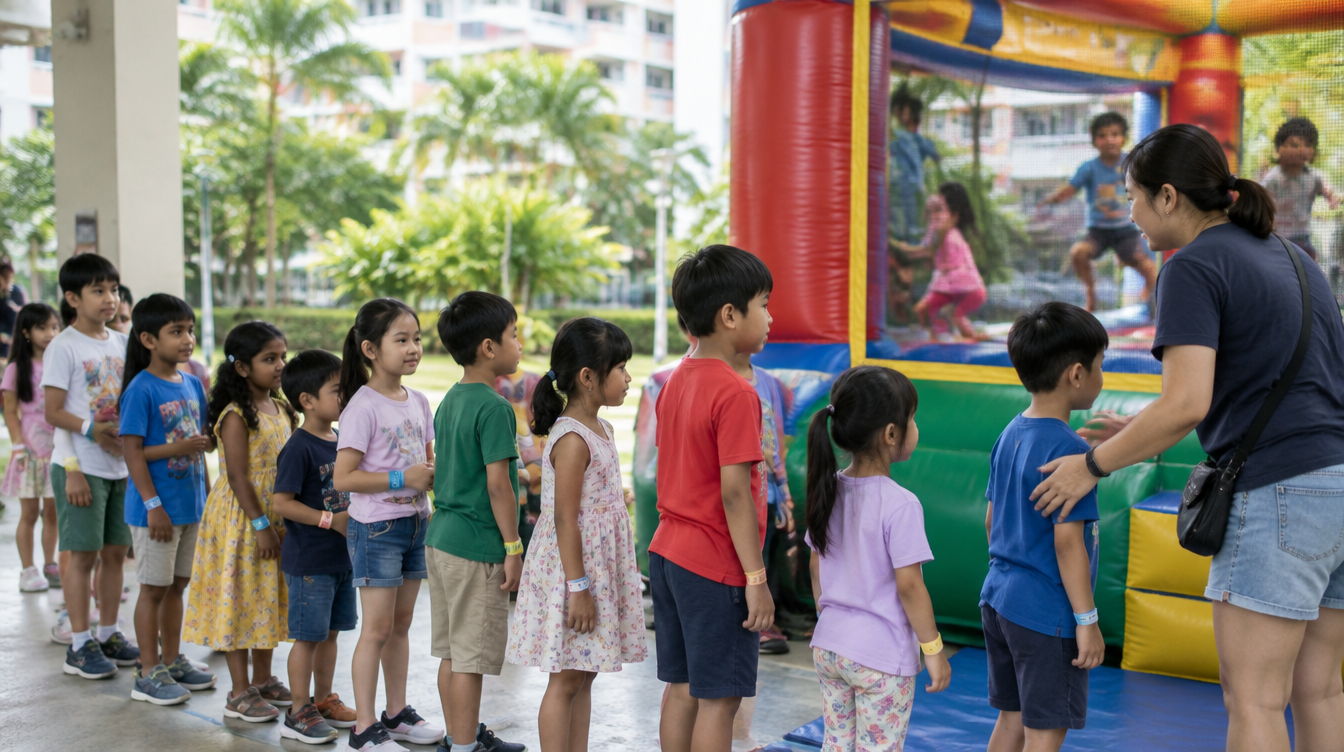
Picture twelve excited children queuing three deep at the bouncy castle entrance, with one harried parent trying to keep the line in some kind of order. It is one of the most common scenes at Singapore birthday parties and school carnivals alike, and it rarely resolves itself on its own. A little planning around turns and timing, decided before the first child climbs on, makes all the difference.
Managing bouncy castle queues well is less about rules and more about rhythm: a session length that suits the group, a clear way to tell whose turn is next, and a line that stays well clear of the bounce area itself. Get that rhythm right and the inflatable becomes the centrepiece everyone remembers for the right reasons, rather than the one spot where tempers frayed.
Why Queues Build Up at Singapore Events
Queues are rarely a sign that anything has gone wrong. They happen because bouncy castles have a natural capacity limit, because children understandably want more than one turn, and because events here often pack a lot into a short window, whether that is a two hour condo function room booking or a school carnival timetable with back to back activity slots. The busier the event, the more useful it is to plan queue management in advance instead of leaving it to whoever happens to be standing nearby.
Setting Session Lengths That Actually Work
A fixed session length, announced clearly at the start, does more to keep a queue moving than almost anything else. Three to five minutes per group is typically enough for most children to feel they have had a proper turn.
The right length depends on the crowd. A small birthday party with ten or fifteen children can afford slightly longer sessions of five to seven minutes, since the queue is short enough for everyone to get several turns. A school carnival or corporate family day with dozens of children cycling through does better with shorter two to three minute sessions, which keep the line moving and reduce the chance of a long wait turning into a flashpoint. Whichever length is chosen, sticking to it consistently helps more than flexibility does, since extending one child’s turn is usually what causes the queue behind to lose patience.
A simple visual timer, or a parent counting aloud for the youngest guests, gives children a concrete sense of when their turn will end, and gives whoever is marshalling the queue something firm to point to.
Keep the Queue Separate From the Bounce Area
Safety and queue management overlap more than hosts often expect. A line of children standing too close to the inflatable’s entrance can easily spill into the bounce area itself, especially once excitement builds. Marking out a waiting zone with a rope, a row of chairs, or a strip of coloured tape gives children a clear boundary to wait behind, and gives the attendant managing the castle a clean sightline to count how many are inside at any one time.
This becomes most important at larger events, where a queue can double back on itself without a clear line marked out in advance.
Age Grouping and Fair Turn-Taking
Mixing very different age groups in the same queue is a common source of friction, since a shy five year old will rarely push to the front ahead of an enthusiastic ten year old. A few simple systems help even out who gets a turn, without needing anyone to act as referee for the whole afternoon.
- Numbered wristbands or stickers handed out in arrival order, so turns follow a visible sequence instead of whoever shouts loudest.
- A class-by-class or table-by-table rotation at school carnivals and corporate family days, so groups take turns together instead of queuing as individuals.
- A younger children’s session at the start of each hour, before the queue builds up and the wait becomes harder for little ones to manage.
- A parent or teacher stationed at the front of the queue, not just the entrance to the castle, to keep the line itself orderly.
- A visible sign-up sheet or chalkboard near the entrance, so children can see where they stand without needing to ask.
When One Bouncy Castle Isn’t Enough
However well a queue is managed, there comes a point where guest numbers simply outpace what a single inflatable can handle. A birthday party is one thing, but a school carnival with three hundred children, or a community event spread across an entire void deck, often calls for more than one unit running at once. This is less an admission that the plan has failed and more a sign the event has grown to a scale that deserves a different approach.
Spacing a second inflatable away from the first, perhaps alternating a bouncy castle with an obstacle course, splits the queue in two and gives children a genuine choice instead of a single line to join. For hosts weighing up whether their event needs that extra capacity, planning multiple inflatables for bigger events comes down to layout, staffing and timing just as much as queue management does.
A Few Extra Considerations for Bigger Events
Larger events bring a few extra wrinkles worth planning for beyond the queue itself. Hydration, shade and rest breaks all affect how patiently children wait their turn, especially on a hot afternoon.
Singapore’s heat and humidity mean children queuing in direct sun tire and grow irritable faster than those waiting somewhere shaded. Positioning the waiting area under a tent, void deck roof, or the shadow of a building keeps the queue calmer for longer. It also helps to schedule the session away from the hottest part of the early afternoon where the timetable allows, since a cooler window of play tends to produce fewer disputes than a long session at the peak of the day’s heat.
Finally, brief whoever is marshalling the queue, whether that is event staff, a teacher, or a willing parent, on the session length and age grouping system in advance. A queue runs far more smoothly when the person managing it feels confident about the system, instead of improvising on the spot.
A smooth queue rarely happens by accident. It takes a session length that suits the crowd, a clear boundary between waiting and bouncing, and a simple system for deciding whose turn comes next, whether that is wristbands, a class rotation, or a sign-up sheet by the entrance. None of it needs to be complicated, and most of it can be sorted out in the few minutes before guests arrive.
If you are planning an event and still working out timing, layout or how many units you might need, get in touch with the team at BouncyCastle.sg and we can help plan it through from delivery to pack-down.