
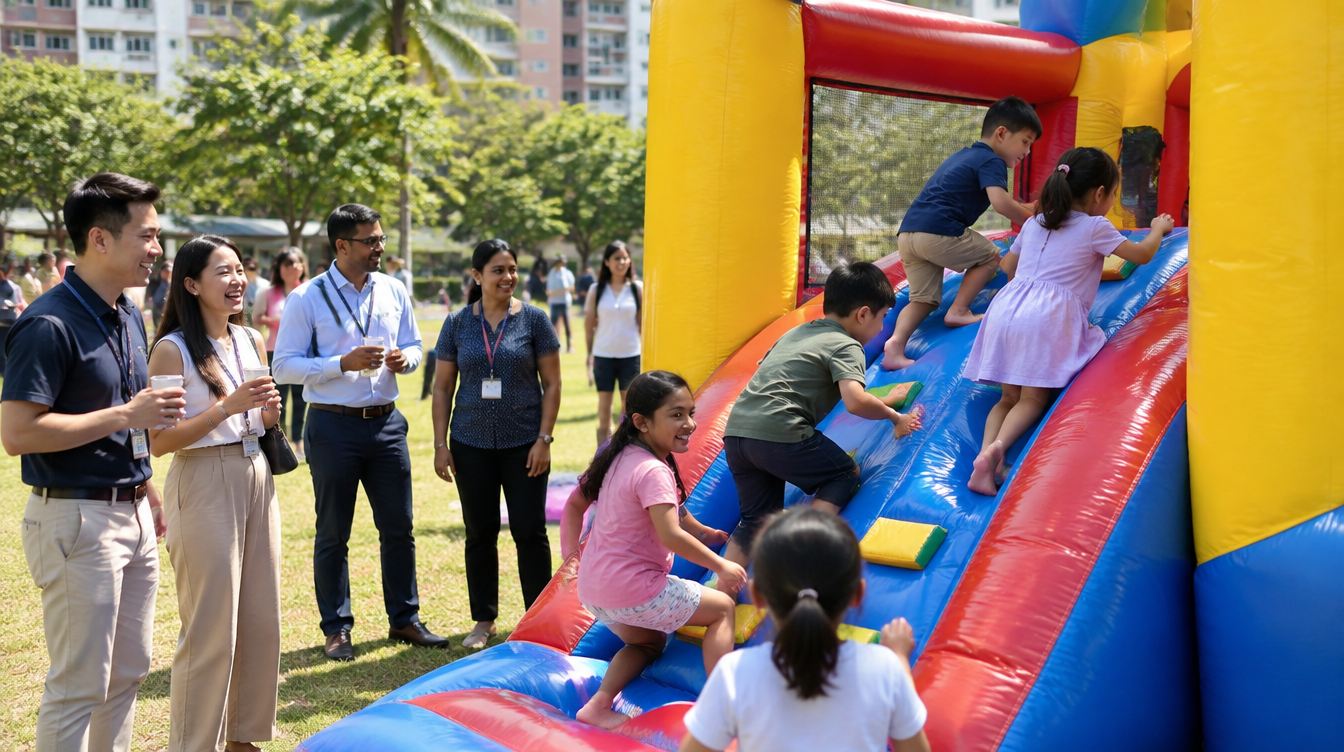
The office group chat has settled on a Saturday, the caterer is confirmed, and someone has already ordered a balloon arch for the entrance. But has anyone worked out where two hundred colleagues and their children will actually stand once the inflatable slide gets going?
A corporate family day looks simple from the outside: pick a date, book a venue, add some entertainment for the kids. In practice it asks for a different kind of planning to a birthday party or a school carnival, because the guest list spans toddlers, primary schoolers and pre-teens, all arriving with parents who have exactly one free weekend day and high expectations for how it goes. Getting the inflatable line-up right, matched to that spread of ages and to the venue you can actually book, is where most of the groundwork happens.
What Makes a Corporate Family Day Different
A birthday party has one age group to plan around and a school carnival has a fixed site with known dimensions. A corporate family day usually has neither. The organiser is often someone from HR or admin, not a parent booking for their own child, the headcount can run into the hundreds once partners and children are added up, and the event has to work for a four-year-old and a twelve-year-old on the same afternoon without either group feeling like an afterthought.
Matching Inflatables to a Mixed-Age Crowd
A classic bouncy castle suits younger children well, with soft walls and a gentle bounce that toddlers and early primary schoolers can manage confidently under a parent’s eye. Older children tend to gravitate towards an inflatable obstacle course instead, where there is a course to complete instead of just space to jump, and a water slide inflatable adds a cooling option for an outdoor afternoon when the weather cooperates.
Rather than picking one inflatable and hoping it suits everyone, many companies split their setup by age zone: a bouncy castle near the younger children’s area, with an obstacle course a short distance away for the older ones. This keeps the smaller children clear of faster-moving older kids and gives each age group equipment genuinely built for them.
Headcount also decides how many units to book. A department of thirty families needs a very different setup to a company-wide event for three hundred, and queue length is usually the first thing that goes wrong when the maths is skipped. A useful rule is to think in terms of children waiting per unit, not total attendees, since a large guest list with only one inflatable means a long, restless queue by early afternoon.
Choosing a Venue That Can Actually Host It
Company premises, a community club field, a condominium function lawn or a public park each come with their own trade-offs. An office compound is convenient and familiar, but not every workplace has open ground that can take an inflatable safely, and indoor spaces bring ceiling height and flooring considerations of their own.
If the venue is a public park or open field managed by the National Parks Board, organisers usually need to apply for an organised group activity permit before the event date. Processing takes time, so it is best handled early, well before the final fortnight of planning. Shade, access to power points and nearby toilets are all sensible to confirm at the same stage, since these tend to shape the day more on a family event than at a typical corporate function.
Building the Event Day Timeline
A family day runs on a tighter schedule than a private party, mostly because vendors, caterers and entertainment are all arriving and setting up within the same window. A simple sequence keeps the morning calm instead of chaotic:
- Confirm a delivery and setup arrival window with a buffer of at least thirty minutes before guests arrive.
- Walk through the safety briefing with the crew once the inflatables are set up and anchored.
- Stagger activity slots by age group so the obstacle course and bouncy castle open at slightly different times.
- Build in a photo or prize moment partway through, which naturally pulls children away from the queues for a break.
- Leave a clear pack-down window before the venue’s closing time instead of treating it as an afterthought.
Coordinating Multiple Inflatables Without the Chaos
Running more than one inflatable at once brings its own logistics, from power points and walkway spacing to staggering start times so queues do not merge into one long line. Coordinating multiple inflatables draws on much the same playbook as a school carnival, except a corporate crowd tends to arrive in waves around meeting breaks and lunch instead of all at once, and colleagues without children often want a turn on the obstacle course too.
Having one point of contact from the company liaise directly with the rental team on the day makes a noticeable difference, particularly once several units and a catering setup share the same patch of grass. It also means any on-site safety check flagged by the crew, such as a peg needing to be reset after wind, gets acted on immediately instead of drifting between departments.
Weather deserves a passing thought too, since an outdoor afternoon in Singapore can turn from bright sun to a sudden downpour within the hour. A simple contingency, such as a covered fallback area or a flexible pack-down plan, saves a lot of scrambling later.
Budgeting and Booking Timelines
Corporate calendars tend to cluster family days around the same few months each year, often tied to a company’s own D&D or appreciation event cycle, and the June and December school holidays add further competition for popular dates. Booking six to eight weeks ahead gives far more choice over equipment and timing than a last-minute request, particularly for larger events needing multiple units.
Costs scale mainly with the number of inflatables and the size of each one, so a useful starting point is deciding the age split and headcount first, then pricing the equipment around that instead of the other way round. A smaller, well-matched setup usually serves a mixed-age crowd better than a single oversized inflatable that only really suits one age group.
A well-run family day event is an exercise in logistics dressed up as an afternoon of fun, and the inflatables are only as good as the planning behind them. Once the venue is confirmed and the age groups are mapped out, choosing the right equipment becomes the easy part. If you would like a hand thinking through venue fit, timing or how many units your headcount actually needs, feel free to get in touch and we can work through it together.